


A PREVIVOR’S STORY
By Nancy Gregory
“My mom was amazing. She was strong as crap.”
Wendy Wade doesn’t mince words as she reflects on her mother’s years-long battle with breast cancer and the moment she learned it was no longer treatable.
“We were there for a chemo treatment and my mom was asleep, facing the window. I looked up and I saw her doctor. She motioned for me and took me into a back hallway. She explained that a blood test they did before administering chemo showed that her kidneys were failing. The cancer had gone too far and they had done everything they could.”
Wade, through tears, said she asked how much time her mom had left. “My mom had wanted to go to the Grand Canyon. We had it booked for two months away. And the doctor said, ‘I don’t think she’s going to live more than three weeks.’”
Wade’s mom – Marilyn Rogers – died 20 days later.
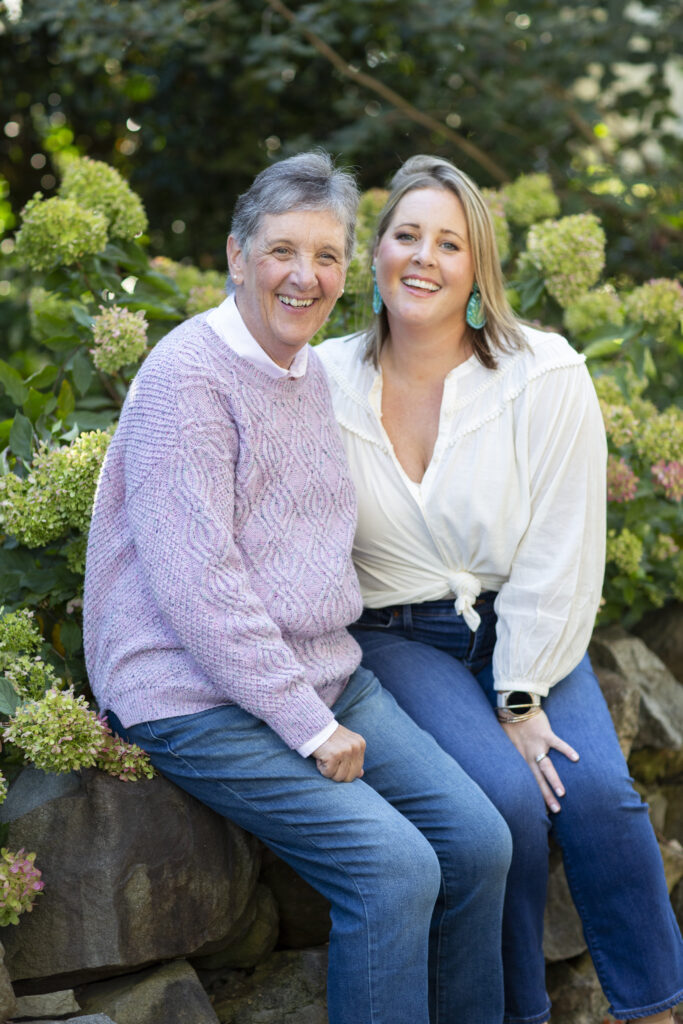
From infancy through adulthood, cancer has been a near-constant presence in Wendy Wade’s life – as a child she punched out the pills from the foil packs that helped extend her father’s life during a clinical trial for Hodgkin lymphoma. As an adult, Wade was at her mother’s side as she battled the aggressive breast cancer that took her life.
The loss of a parent is profound for anyone. For Wade, it also proved to be a pivotal, lifesaving event.
Wade, who grew up in Falls Church and now lives in Brambleton with her husband, Jason, and two children, Sophie and Wes, recalls how her mother’s cancer advanced “with a vengeance,” decades after her mom had survived an earlier bout with breast cancer.
“It was just happening so quickly and so I think after going through that and watching how cruel it was in those final weeks … that led me to say, ‘I want to use whatever time I have left here to be the healthiest version of me that I can be,’” Wade said.
Still grieving after her mother died in May 2024, yet galvanized by her unforgiving journey with cancer, Wade underwent genetic testing at the Inova Saville Cancer Screening and Prevention Center in Fairfax to learn more about her own health.
She didn’t expect to learn anything of note. She knew her mother had been tested and didn’t have either of the BRCA1 or BRCA2 gene mutations closely associated with an elevated risk of breast cancer.

Her father had lived nearly 18 years with non-Hodgkin’s lymphoma before succumbing to the disease just two months short of Wade’s high school graduation. As a healthy 44-year-old who kept up with annual physicals, Wade thought she was in the clear.
Elizabeth Stark, a senior genetic counselor at Inova Saville, said she also expected Wade’s results to be negative.
“Instead, her results showed a BRCA mutation that we ultimately learned came from her father and was completely unrelated to the reason she came to Saville,” Stark said. “That was unexpected and rare.”
More than 60% of women with BRCA1 mutations will develop breast cancer in their lifetime and 39% to 58% of them will develop ovarian cancer, according to the National Cancer Institute.
The news was another emotional shock for the Wade family.
“We’d just gone through the entire, exhausting cancer battle with her mom and were trying to pick up the pieces and move forward – and now this,” said Jason Wade. “Fear turned to anger and resentment that my wife, my family, would have to endure another life-changing event in such a short period of time. But in time, I was left with only resolve and pride. My wife is one of the strongest, most resilient people I’ve met.”
And unlike her parents, Wade was now empowered to make choices that could significantly reduce her risk of developing cancer and change her life.
“From the start, Wendy saw the big picture,” Stark said. “She understood that knowledge is power and that her story didn’t have to mirror her mom’s. While genetic results can feel overwhelming, this information has been in Wendy’s cells since birth and now she can use it to her advantage. Wendy faced the unimaginable in losing both parents to cancer, and she turned that pain into action.”
Wade had decisions to make – even while she was still mourning and processing life-changing news.
“I felt like I was getting a diagnosis … but it wasn’t really a diagnosis,” Wade said. “I felt like I was being told that I had cancer, but I didn’t have cancer at all, right?”

Wade had to decide whether to undergo surgeries to reduce the risk of developing ovarian cancer and breast cancer or opt for enhanced, more frequent screening. Given that there are no effective methods of detecting early stage ovarian cancer, Wade said the decision to get a hysterectomy was somewhat easier.
“She never wavered in her goal to improve her survival and health,” said Dr. Jessica Lee, a gynecologic oncologist who performed Wade’s surgery last January.
The next decision – to have a double mastectomy – was deeply emotional, but with her family’s full, unconditional support, Wade is preparing for this preventative surgery.
“I would just kick myself if I sat on the information for too long, and then something happened,” Wade said. “I have to keep moving … every day that I don’t, it’s still a threat.”
Amid the whirlwind of doctor’s appointments, grief, a career as a graphic designer and being a mom of two, Wade has embraced publicly sharing her story in the hopes of helping others. She has told her story to local and regional media outlets and in September, she was the honorary captain of a Washington Spirit soccer game at Audi Field. A synopsis of her story was shared on the stadium’s jumbo video screen.
“BRCA feels to me like it’s been placed in my heart to share,” Wade said. “And the more I share it, the more the universe is telling me to keep sharing.”
Both Lee and Stark, members of Wade’s health care team, encourage people to learn more about their family history to determine whether they are a candidate for genetic testing, even if these conversations are difficult. The simple saliva or blood test may be covered by insurance, depending on risk factors and the patient’s plan. Otherwise, the out-of-pocket cost usually runs around $250.
Wade is determined to remain a previvor, a term used to describe a survivor of a predisposition to cancer, typically someone with an inherited mutation who has never been diagnosed with cancer.
“It’s a powerful word … it’s taking the bull by the horns,” Wade said. “My husband said something in the very, very beginning of my journey, and I will never forget this, and it was like, I have to do all this to fight the boogeyman. And [he said] ‘We don’t ever know if you are going to meet the boogeyman, right? He might not ever show up. But you have to be prepared to fight.’”
It’s the same battle her dad bravely fought, enrolling in clinical trials for his cancer and living by the philosophy that cancer gave him a reason to be the best father he could be, enjoy the life he had and not be consumed by worry. Wade said her mom had the same mentality, and although she had hope and optimism that she would beat cancer the second time around, it came on too fast and too aggressively.
Reflecting on the tragic turn of events that has led Wade on her journey as a previvor, she often finds herself contemplating the difficult but undeniable link between loss and life.
“The weird thing is, and I still grapple with this almost daily – is had my mom not died, I would have never found out,” Wade said. “Everything happens for a reason, even if you don’t necessarily understand why it’s happening. Sometimes, I feel like my mom died so I could find out.”
Nancy Gregory is an Ashburn resident and a communications professional who has worked as a daily newspaper reporter and now leads media relations for a national nonprofit.